
Inside converted shipping containers, growers are producing everything from lettuce and herbs to hydroponic strawberries using vertical growing systems, LED lights, circulating water, and carefully controlled temperatures. These shipping container farms can operate throughout the year without depending on good soil, favorable weather, or a traditional growing season.
The basic idea behind container hydroponic farming is fairly simple. Start with a standard shipping container, insulate it, add water and electrical service, and install the lighting, climate controls, and growing equipment needed to create a small controlled environment.
What happens inside is considerably more sophisticated.
How Much Can a Shipping Container Farm Grow?
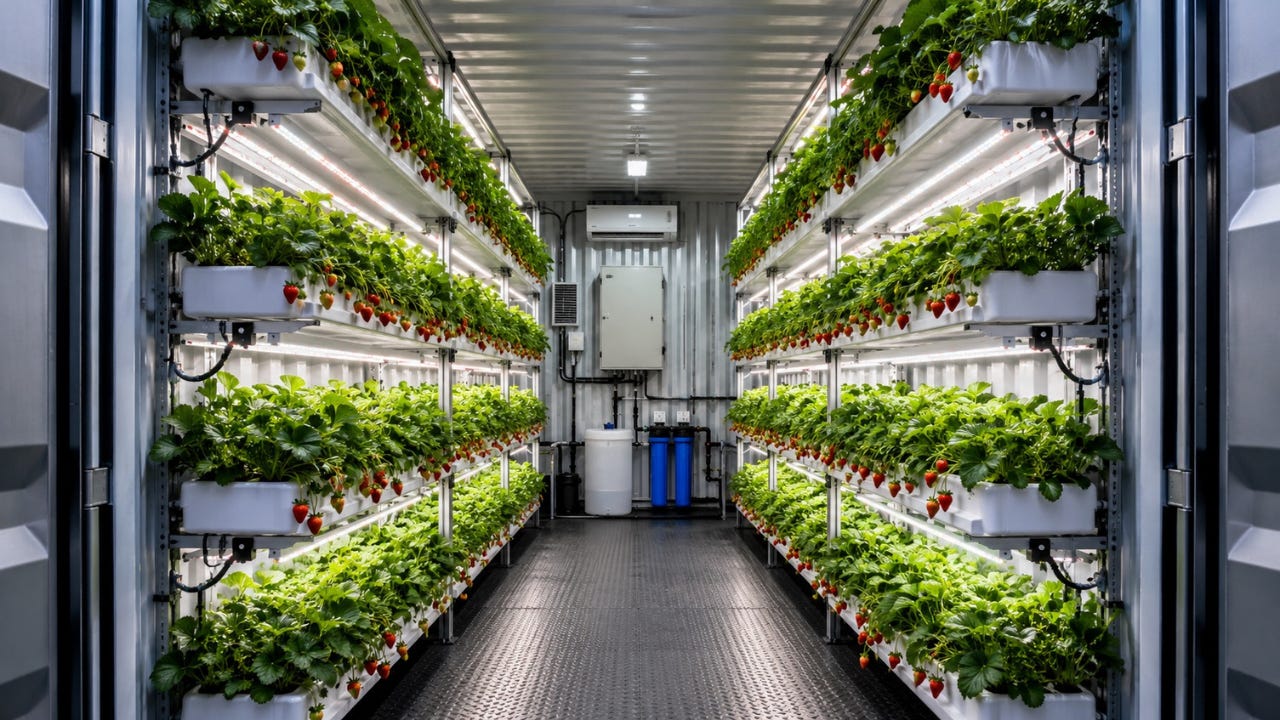
A standard 40-foot shipping container provides around 320 square feet of floor space, but container farms make much greater use of that room by growing vertically.
Instead of spreading plants across a single level, growers install racks, panels, or vertical towers that allow plants to grow along the walls. Depending on the design, thousands of plants can fit into a container with a relatively small footprint.
Freight Farms’ Greenery S, for example, is built inside a 40-foot container and includes 8,800 plant sites. The company says the system can produce between two and six tons of food annually and has been used to test more than 500 crop varieties.
Lettuce and other leafy greens are some of the most common choices because they grow relatively quickly and work well in hydroponic systems. Herbs, microgreens, edible flowers, brassicas, and some root vegetables can also be grown this way.
And growers are beginning to push beyond the crops most commonly associated with vertical farming.
Strawberries are just one example.
How Hydroponics Work Inside a Shipping Container Farm
Most shipping container farms use hydroponics rather than soil.
Plant roots receive water mixed with the nutrients they need to grow. Depending on the system, the nutrient solution may be delivered through drip irrigation, channels, or another method before being collected and circulated through the system again.
This closed-loop approach can make very efficient use of water. Freight Farms, for example, lists average water consumption for its Greenery S at about five gallons per day.
Sensors and control systems also allow growers to keep a close eye on what is happening inside the container. Temperature, humidity, lighting, water chemistry, and other conditions can be monitored and adjusted instead of being left to whatever the weather happens to bring that day.
Some systems can be checked remotely, allowing an operator to monitor farm conditions through software without being inside the container around the clock.
The technology does not eliminate the work of farming. Seeds still need to be started, seedlings moved into the growing system, crops harvested, equipment cleaned, and plants regularly checked.
It simply gives the grower much greater control over the conditions in which that work takes place.
Strawberries Show What Container Farming Can Do
Lettuce, herbs, and microgreens are natural fits for container farms. They grow quickly, require relatively little space, and have been grown hydroponically for years.
Strawberries are more complicated.
GetBlok Farms in West Aliquippa, Pennsylvania, offers a good example of how growers are taking on that challenge. The company operates hydroponic farms inside insulated 40-foot shipping containers, where it has grown crops including lettuce, arugula, carrots, turnips, and herbs throughout the year.
More recently, GetBlok began dedicating one of its containers to hydroponic strawberries.
By March 2026, strawberries were ripening inside the container months before Pennsylvania’s normal outdoor strawberry season. Instead of relying on spring weather, GetBlok controls the light, humidity, temperature, and water chemistry surrounding the plants.
Getting there took some experimenting.
The company had previously tried growing strawberries alongside its leafy greens, but the fruit needed different conditions. According to GetBlok co-founder Vinnie Lima, those early berries did not reach the size or ripen in the way the company wanted.
GetBlok eventually gave the strawberries their own container and began testing different varieties, nutrients, and growing conditions. Trials for the dedicated strawberry operation began in August 2025. By the following winter, the farm was harvesting and selling several varieties, including Albion, San Andreas, Portola, and Seascape.
There was another problem to solve: pollination.
There are no bees naturally moving from flower to flower inside a sealed shipping container, so GetBlok had to develop its own method for pollinating the strawberry plants. The farm tested several approaches before settling on a technique that produced more consistent fruit.
That makes strawberries a useful example of both the possibilities and the limitations of container farming.
A controlled environment gives growers the ability to change temperature, moisture, lighting, and nutrients to suit a particular crop. But more control does not necessarily mean a crop is easier to grow. Sometimes it means the operator has to recreate processes that would normally happen outdoors on their own.
Climate Control Makes the Farm Possible
One of the biggest challenges of growing inside a shipping container is also one of the most obvious: the container is made of steel.
An unmodified container can become extremely hot in direct summer sun and lose heat quickly in cold weather. Those swings are the opposite of what most crops need.
That makes insulation one of the most important parts of a shipping container farm conversion.
Insulation creates a thermal barrier between the growing area and outside conditions. Heating, cooling, ventilation, and dehumidification systems then maintain the environment the plants require.
How much climate control is needed depends heavily on location.
A shipping container farm in Minnesota will face a different set of challenges than one in Arizona or Florida. In either case, good insulation helps keep outside temperatures from dictating what happens inside.
Commercial container farms can be designed for surprisingly wide temperature ranges. Freight Farms rates the Greenery S for operation in outdoor temperatures ranging from -40°F to 120°F.
Of course, keeping plants comfortable when the outside temperature is at one of those extremes takes energy.
What Does a Shipping Container Farm Cost?
There is no single price for converting a shipping container into a farm.
A custom project might start with an empty new or used 40-foot container and add each component separately. That can include insulation, vertical growing equipment, LED lighting, HVAC, plumbing, pumps, electrical work, sensors, water treatment, and control systems.
How elaborate those systems become will have a major effect on the final cost.
The other option is to purchase a turnkey container farm where much of that work has already been done.
Those units can be a significant investment. Freight Farms currently lists its Greenery S at $215,000 for an outright purchase. The company also offers a farm-as-a-service option starting at about $3,000 per month through a financing partner.
A grower building a simpler system from an empty container may spend considerably less, but the price of the container itself is only one piece of the budget.
The real calculation also needs to include site preparation, electrical service, water access, climate-control equipment, grow systems, permits, labor, and ongoing operating expenses.
Electricity Is a Major Part of the Equation
Sunlight is free. LED grow lights are not.
Lighting is one of the biggest differences between a field farm and a fully enclosed container farm. Plants growing inside a steel container depend heavily on artificial light, often for many hours every day.
HVAC equipment also has to maintain temperature and humidity, while pumps, fans, sensors, and water-treatment equipment add to the electrical load.
Freight Farms lists power consumption for the Greenery S between 151 and 350 kWh per day, with actual use depending on factors such as crop type, humidity, and outside climate.
That makes location and insulation especially important.
If an HVAC system spends all summer fighting extreme heat or all winter trying to keep an poorly insulated container warm, operating costs can add up quickly.
Crop selection matters too.
Fast-growing greens allow farmers to move several harvests through the same growing space. Strawberries take a different approach. They require more precise management and take longer to produce, but they can offer access to a higher-value crop, particularly during times of year when locally grown berries are difficult to find.
At GetBlok, that means producing Pennsylvania-grown strawberries during winter and early spring instead of waiting for the traditional late-May growing season to begin.
Why Put a Farm in a Shipping Container?
Consistency is a big part of the appeal.
Traditional agriculture depends on rain, temperatures, sunlight, soil conditions, pests, and the length of the local growing season. Indoor farming removes many of those variables.
A properly designed shipping container farm can create similar growing conditions in January and July.
It can also put food production much closer to the people eating it.
A shipping container does not require acres of farmland. Depending on local zoning and site requirements, a farm can potentially be placed on a relatively small property near restaurants, grocery stores, schools, universities, or the communities it serves.
GetBlok is a good example. Its operation sits in Aliquippa, just outside Pittsburgh, rather than on a large traditional farm. Its original container farms were established in an urban setting with a focus on producing fresh food locally.
That shorter distance between farm and customer can be particularly useful for crops that are best eaten fresh.
What Does a Shipping Container Farm Need on Site?
A container farm has a small footprint, but that does not mean it can go anywhere without preparation.
The container first needs a firm, level surface. Keeping it level becomes particularly important once the interior contains water tanks, pumps, growing racks, and drainage systems.
There also needs to be enough space for the delivery truck to position the container and for operators to access the doors and equipment afterward.
Utilities are another major consideration.
Hydroponic farms need a dependable water source as well as enough electrical capacity to operate the lights, HVAC equipment, pumps, fans, sensors, and other systems. Some commercial setups may require electrical upgrades before the farm can operate.
Local zoning, permits, drainage, and building requirements should also be checked before the container arrives.
Planning for those details early is much easier than trying to relocate or redesign a completed farm later.
Why Shipping Containers Work Well for Indoor Farming
Shipping containers were never designed to grow food, but many of the same characteristics that make them useful for cargo also make them a practical shell for indoor agriculture.
They are strong, enclosed, transportable, and built to standardized dimensions.
A 40-foot container gives the builder a predictable structure to work with instead of requiring an entirely new building. Once it has been properly insulated and modified, the interior can be designed specifically around the crop and growing system.
Used shipping containers can also be an option when exterior appearance is less important than structural condition. For a farm conversion, the priorities are a sound container that can be made weather-tight, insulated, and safely modified for the necessary utilities and equipment.
Containers also make the idea modular.
An operator can start with one unit and potentially add additional containers later, with each one providing its own controlled growing environment. Individual containers could even be set up for different crops, as GetBlok found when strawberries needed different conditions from its leafy greens.
A Different Kind of Second Life for Shipping Containers
Container farming is still evolving.
Lighting is becoming more efficient. Sensors and software are giving growers more information about what is happening around their plants. Automation can handle some routine adjustments, while farmers continue experimenting with crops that would once have seemed unlikely candidates for a steel box.
GetBlok’s strawberries are a good example.
A shipping container cannot change Pennsylvania’s growing season outside its doors. Inside, however, growers can create an entirely different set of conditions and harvest strawberries while fields nearby are still waiting for spring.
That does not mean every crop makes financial or practical sense in a container.
Anyone considering a shipping container farm still has to answer some basic questions: What will the conversion cost? How much electricity will it use? What does the site need? Which crops work in the available space? And is there enough local demand to make the operation worthwhile?
Get those pieces right, and a shipping container that once spent its life moving cargo can take on a very different job: growing food year-round, sometimes just a few miles from the people who will eat it.
Frequently Asked Questions About Shipping Container Farms
What Can You Grow in a Shipping Container Farm?
Leafy greens, lettuce, herbs, microgreens, edible flowers, brassicas, and certain root vegetables are common choices. Commercial systems have tested hundreds of crop varieties, and operations such as GetBlok show that fruiting crops like strawberries can also be grown when the system is designed around their needs.
How Much Does a Shipping Container Farm Cost?
Costs vary widely depending on how the farm is built. A custom conversion may start with an empty new or used container and add equipment separately. Complete commercial systems can cost considerably more.
Do Shipping Container Farms Need Water?
Yes, although hydroponic systems can make very efficient use of it by recirculating water instead of constantly replacing it. Water requirements depend on the farm design and crops being grown.
Do Shipping Container Farms Use a Lot of Electricity?
They can. LED lighting and climate control account for a large part of the energy demand, while pumps, fans, sensors, and other equipment also require electricity. Climate, insulation, crop choice, and equipment efficiency can all affect the amount used.
Can a Shipping Container Farm Operate in Winter?
Yes. With sufficient insulation and climate-control equipment, container farms can operate throughout the winter. GetBlok’s hydroponic strawberries in Pennsylvania are one example of how a controlled container environment can produce crops well outside their traditional local growing season.